TERMS TO KNOW
| |
Exclusion ratio – calculation method used to determine the annuity amounts to be excluded from taxes
LIFO (Last In, First Out) – principle applied to asset management in life insurance products, under which it is assumed that the funds paid into the policy last will be paid out first FIFO (First In, First Out) – principle under which it is assumed that the funds paid into the policy first will be paid out first Policy endowment – maturity date Policy proceeds – in life insurance, the death benefit Surrender – early termination of a policy by the policyowner | |
A. Taxation of Personal Life Insurance
Generally speaking, the following taxation rules apply to life insurance policies:
- Premiums are not tax deductible;
- Death benefit:
- Tax free if taken as a lump-sum distribution to a named beneficiary;
- Principal is tax free; interest is taxable if paid in installments (other than lump sum).

1. Amounts Available to Policyowner
As you have already learned, permanent life insurance provides living benefits. There are several ways in which policyowners may receive those living benefits from the policy.
Cash Value Increases
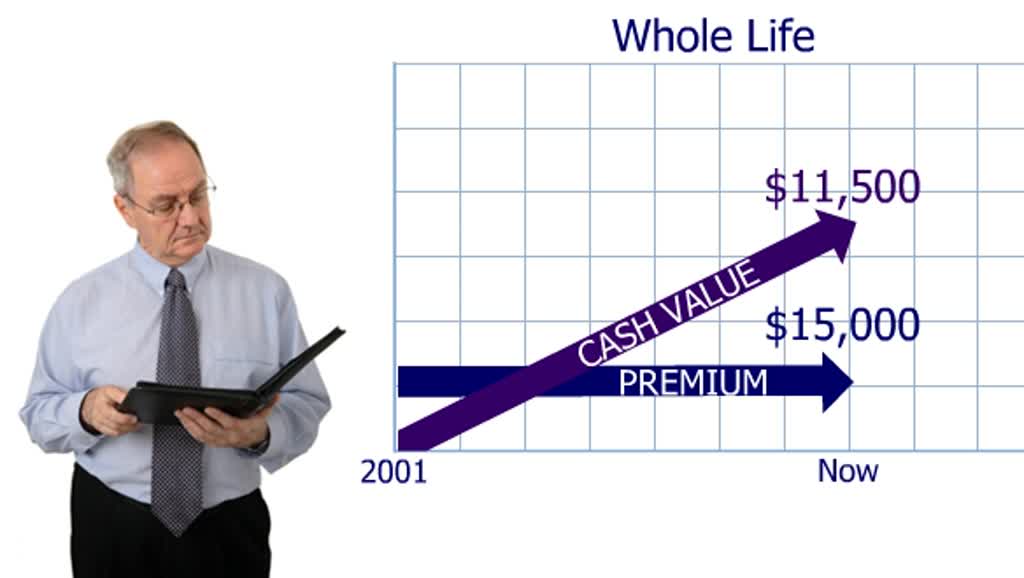
Any cash value accumulations in the policy can be borrowed against by the policyowner, or may be paid to the policyowner upon surrender of the policy. Cash values grow tax deferred. Upon surrender or endowment, any cash value in excess of cost basis (premium payments) is taxable as ordinary income. Upon death, the face amount is paid, and there is no more cash value. Death benefits generally are paid to the beneficiary income tax free.

Dividends
Since dividends are a return of unused premiums, they are not considered income for tax purposes. When dividends are left with the insurer to accumulate interest, the interest earned on the dividend account is subject to taxation as ordinary income each year interest is earned, whether or not the interest is paid out to the policyowner.
Policy Loans
The policyowner may borrow against the policy's cash value. Money borrowed against the cash value is not income taxable; however, the insurance company charges interest on outstanding policy loans. Policy loans, with interest, can be repaid in any of the following ways:
- By the owner while the policy is in force;
- At policy surrender or maturity, subtracted from the cash value; or
- At the insured's death, subtracted from the death benefit.
Surrenders
When a policyowner surrenders a policy for cash value, some of the cash value received may be taxable as income if the cash surrender value exceeds the amount of the premiums paid for the policy. When the owner withdraws cash value from a universal life policy (partial surrender), both the cash value and the death benefit are reduced by the surrender.
Example:
Consider the following scenario:
- Face amount: $300,000
- Premiums paid: $70,000
- Total cash value: $100,000
If the insured surrendered $30,000 of cash value, the full $30,000 would be income tax free. If the insured took out $100,000, the last $30,000 would be taxable because the $100,000 exceeds the premiums that were paid in by $30,000.
2. Amounts Received by Beneficiary
General Rule and Exceptions
Life insurance proceeds paid to a named beneficiary are generally free of federal income taxation if taken as a lump sum. An exception to this rule would apply if the benefit payment results from a transfer for value, meaning the life insurance policy is sold to another party prior to the insured's death.
Settlement Options
With settlement options, when the beneficiary receives payments consisting of both principal and interest, the interest portion of the payments received is taxable as income.
Example:
If $100,000 of life insurance proceeds were used in a settlement option paying $13,000 per year for 10 years, $10,000 per year would be income tax free and $3,000 per year would be income taxable.
PERMANENT LIFE FEATURES
|
TAX TREATMENT
|
| Premiums | Not tax deductible |
| Cash value exceeding premiums paid | Taxable at surrender |
| Policy loans | Not income taxable |
| Policy dividends | Not taxable |
| Dividend interest | Taxable in the year earned |
| Lump-sum death benefit | Not income taxable |
B. Taxation of Annuities
1. Individually-owned
A portion of each annuity benefit payment is taxable and a portion is not. The portion that is nontaxable is the anticipated return of the principal paid in. This is known as the cost base. The portion that is taxable is the interest earned on the principal. This is known as the tax base.
The exclusion ratio is used to determine the annuity amounts to be excluded from taxes. The annuitant is able to recover the cost basis nontaxable. The cost basis is the principal amount, or the amount that was paid into the annuity, which is excluded from taxes. The rest of each annuity payment is interest that has been earned and is taxable.
Tax-deferred Accumulation
The cost base represents the premium dollars that have already been taxed and will not be taxed again when withdrawn from the contract. The interest accumulated in an annuity is the tax base, but the taxes are deferred during the accumulation period.
2. Corporate-owned
Corporate-owned annuities have different tax implications than individual annuities:
- Growth in the annuity is not tax deferred;
- Interest income is taxed annually unless the corporation owns a group annuity for its employees and each employee receives a certificate of participation.
C. Taxation of Individual Retirement Annuities (IRAs)
1. Traditional IRAs
Contributions, Deductible Amounts, and Distributions
The following taxation rules apply to contributionsmade to traditional IRA plans:
- Tax-deductible contributions for the year of the contribution (based on the person's income);
- Contributions must be made in "cash" in order to be tax deductible (the term cash includes any form of money, such as cash, check, or money order);
- Excess contributions are taxed at 6% per year as long as the excess amounts remain in the IRA;
- Tax-deferred earnings (the money that accumulates in the account) are not taxed until withdrawn.
A distribution from an IRA is subject to income taxation in the year the withdrawal is made. In case of an early distribution (prior to age 59 ½), a 10% penalty will also apply.
There are certain conditions, under which the 10% penalty for early withdrawals would not apply (penalty tax exceptions):
- Participant is age 59½;
- Participant is totally disabled;
- The money is used to make the down payment on a home (not to exceed $10,000, and usually for first-time homebuyers);
- Withdrawals are for post-secondary education expenses; and
- Withdrawals are for catastrophic medical expenses, or upon death.
Amounts Received by Beneficiary
If the owner dies before distributions have begun, the entire interest must be distributed in full on or before December 31 of the calendar year that contains the 5th anniversary of the owner’s death, unless the owner named a beneficiary. If a beneficiary is named, the interest payable to the beneficiary may be distributed over the life of the beneficiary beginning not later than December 31 of the year following the owner’s death. If the beneficiary is the owner’s spouse, he or she may choose either to receive the distributions by December 31 of the year immediately following the owner's death or leave the money in the tax-deferred account until the calendar year in which the owner would have attained age 70½. At that time, the distributions would be subject to income taxation.

2. Roth IRAs
The following taxation rules apply to Roth IRAs:
- Contributions are not tax deductible;
- Excess contributions are subject to a 6% tax penalty.
| TRADITIONAL IRA | ROTH IRA |
Contribute 100% of income up to an IRS-specified limit
| |
Excess contribution penalty is 6%
| |
| Grows tax deferred | Grows tax free (if account open for at least 5 years) |
| Contributions are tax deductible (Made with "pre-tax dollars") | Contributions are nottax deductible (Made with "after-tax dollars") |
| 10% penalty for early nonqualified distributions prior to age 59 ½ (some exceptions apply) Distributions are taxable | Qualified distribution cannot occur until account is open for 5 years and owner is 59½ Distributions are nottaxable |
| Payouts must begin by 70½ | Payouts don't have to begin by 70½ |
D. Rollovers and Transfers (IRAs and Qualified Plans)
Situations exist in which a person may choose to move the monies from one qualified retirement plan to another qualified retirement plan. However, benefits that are withdrawn from any qualified retirement plan are taxable the year in which they are received if the money is not moved properly. There are 2 ways to accomplish this: a rollover and a transfer from one account to another.
A rollover is a tax-free distribution of cash from one retirement plan to another. Generally, IRA rollovers must be completed within 60 days from the time the money is taken out of the first plan. If the distribution from the first plan is paid directly to the participant, 20% of the distribution must be withheld by the payor. The 20% withholding of funds can be avoided if the distribution is made directly from the first plan to the trustee or administrator/custodian of the new IRA plan. This is known as direct rollover.
The term transfer (or direct transfer) refers to a tax-free transfer of funds from one retirement program to a traditional IRA or a transfer of interest in a traditional IRA from one trustee directly to another.
E. Section 1035 Exchanges
In accordance with Section 1035 of the Internal Revenue Code, certain exchanges of life insurance policies and annuities may occur as nontaxable exchanges. When a policyowner exchanges a cash value life insurance policy for another cash value life insurance policy, or a cash value life policy for an annuity, or an annuity for an annuity, the policies or annuities must be on the same life. There will be no income tax on these transactions.
The following are allowable exchanges:
- A life insurance policy for another life insurance policy, an endowment contract, or an annuity contract;
- An endowment contract for another endowment contract or an annuity contract; or
- An annuity contract for another annuity contract.
Note that a policyowner may not exchange funds from an annuity into a cash value life policy. Nor would term life be used in a 1035 Exchange since it has no cash value. The key is that the exchange may not be from a less tax-advantaged contract to a more tax-advantaged contract. "Same to same" is acceptable.
TAX CONSIDERATIONS FOR LIFE INSURANCE AND ANNUITIES
| |
| Premiums |
Not deductible (personal expense)
|
| Death Benefit | Not income taxable (except for interest) |
| Cash ValueIncreases | Not taxable (as long as policy in force) |
| Cash Value Gains | Taxed at surrender |
| Dividends | Not taxable (return of unused premium; however, interest is taxable) |
| Accumulations | Interest taxable |
| Policy Loans | Not income taxable |
| Surrenders | Surrender value - past premium = amount taxable |
Partial Surrenders
|
First In, First Out (FIFO)*
|
| Settlement Options—Death benefit spread evenly over income period (averaged). Interest payments in excess of death benefit portion are taxable. |
| Estate Tax—If the insured owns the policy, it will be included for estate tax purposes. If the policy is given away (possibly to a trust) and the insured dies within 3 years of the gift, the death benefit will be included in the estate. |
*FIFO applies to Life insurance only. Annuities follow a LIFO format.
F. Chapter Recap
This chapter explained the basic taxation principles for life insurance and annuities. Let's recap the taxable, tax-deductible and tax-free features and transactions:
| TAXATION | |
| Life Insurance |
|
| Annuities |
|
| IRAs |
|
| Roth IRAs |
|
| OTHER RELATED CONCEPTS | |
| Rollovers and Transfers |
|
| 1035 Exchange |
Nontaxable if on the same life and one of the following exchanges:
|
| Modified Endowment Contract(MEC) |
|
Chapter Complete